Mostrando postagens com marcador desemprego. Mostrar todas as postagens

quinta-feira, julho 25, 2013

O último pilar ruindo

Fonte: Folha

Rodrigo Constantino

O nível de emprego costuma ser lagging enquanto indicador econômico. Na verdade, ele é mais um efeito do que qualquer coisa. Quando um ciclo de excessos possíveis graças à bonança creditícia se esgota, isso só bate na taxa de desemprego depois. 

Isso acontece porque demitir e contratar custa muito caro, especialmente no Brasil. Os empresários esperam até o limite para tomar essa decisão drástica de mandar gente embora.

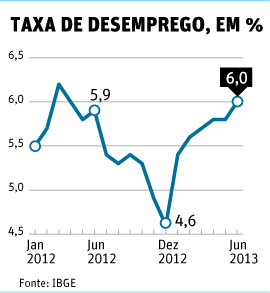
É o que parece estar começando a acontecer no Brasil. O editorial da Folha relata que desde 2009 o país não tinha um ano que terminava com a taxa de desemprego maior do que começou. Diz o jornal:

São consistentes os sinais de deterioração da economia brasileira. Às evidências já conhecidas soma-se agora a taxa de desemprego, que, pela primeira vez desde 2009, apresenta uma alta em relação ao mesmo mês do ano anterior.

O dado negativo no mercado de trabalho é particularmente ruim na atual conjuntura, em que os indicadores de confiança na economia também têm constituído um quadro desalentador.

[...]
É justamente nessa armadilha que caiu o governo federal ao conduzir a política econômica de forma errática e interferir, muitas vezes de forma autoritária, na dinâmica empresarial de vários setores.

O que ainda mantinha a esperança em uma recuperação era o mercado de trabalho. De fato, era algo surpreendente a resistência do emprego no cenário de baixo crescimento do PIB.

Pois agora o aparente paradoxo começa a se resolver --pelo lado ruim. A taxa de desemprego de junho, de 6%, ainda é, em si, baixa, mas a primeira elevação do índice (na comparação anual) desde agosto de 2009 indica mudança de tendência no mercado de trabalho.

É certo que as manifestações recentes contribuíram para a queda dos indicadores de confiança do consumidor, já que elas chamaram a atenção para diversos pontos de descontentamento. Não se descarta alguma melhora nesse item.

Quanto ao mercado de trabalho, porém, é improvável uma reversão. Por ser custoso contratar e demitir, o emprego é o último a sair da inércia diante de mudanças de cenário. Mas, uma vez em movimento, é difícil de parar.

Em meu mais recente artigo no GLOBO, fiz justamente um alerta sombrio para esse quadro. Eu disse:

Portanto, eis a situação: vamos muito mal das pernas, com baixo crescimento, parcos investimentos, e alta inflação. Mas isso tudo em um cenário em que ainda há abundância de capital nos mercados e forte crescimento chinês. Como efeito disso, ainda temos um quadro de pleno emprego. Pergunta: o que acontece com a inadimplência dos bancos se o desemprego subir, lembrando que o governo vem aumentando em mais de 20% ao ano o crédito público? Pois é...

O nível baixo de desemprego é, ainda, o grande ativo político da presidente Dilma, e o que sustenta a economia patinando, em vez de ela afundar de vez. Será que este último pilar está agora ruindo também? Se a taxa de desemprego subir rapidamente, o Brasil viverá uma crise de grandes proporções. Há muita gente pendurada em dívida cujo pagamento depende do emprego. Apertem os cintos...

quarta-feira, outubro 10, 2012

I Was Right About That Strange Jobs Report


Imagine a country where challenging the ruling authorities—questioning, say, a piece of data released by central headquarters—would result in mobs of administration sympathizers claiming you should feel "embarrassed" and labeling you a fool, or worse.
Unfortunately for those who would like me to pipe down, the 7.8% unemployment figure released by the Bureau of Labor Statistics (BLS) last week is downright implausible. And that's why I made a stink about it.Soviet Russia perhaps? CommunistChina? Nope, that would be the United States right now, when a person (like me, for instance) suggests that a certain government datum (like the September unemployment rate of 7.8%) doesn't make sense.
Before I explain why the number is questionable, though, a few words about where I'm coming from. Contrary to some of the sound-and-fury last week, I do not work for the Mitt Romney campaign. I am definitely not a surrogate. My wife, Suzy, is not associated with the campaign, either. She worked at Bain Consulting (not Bain Capital) right after business school, in 1988 and 1989, and had no contact with Mr. Romney.
The Obama campaign and its supporters, including bigwigs like David Axelrod and Robert Gibbs, along with several cable TV anchors, would like you to believe that BLS data are handled like the gold in Fort Knox, with gun-carrying guards watching their every move, and highly trained, white-gloved super-agents counting and recounting hourly.
Let's get real. The unemployment data reported each month are gathered over a one-week period by census workers, by phone in 70% of the cases, and the rest through home visits. In sum, they try to contact 60,000 households, asking a list of questions and recording the responses.
The possibility of subjectivity creeping into the process is so pervasive that the BLS's own "Handbook of Methods" has a full page explaining the limitations of its data, including how non-sampling errors get made, from "misinterpretation of the questions" to "errors made in the estimations of missing data."Some questions allow for unambiguous answers, but others less so. For instance, the range for part-time work falls between one hour and 34 hours a week. So, if an out-of-work accountant tells a census worker, "I got one baby-sitting job this week just to cover my kid's bus fare, but I haven't been able to find anything else," that could be recorded as being employed part-time.
Bottom line: To suggest that the input to the BLS data-collection system is precise and bias-free is—well, let's just say, overstated.
Even if the BLS had a perfect process, the context surrounding the 7.8% figure still bears serious skepticism. Consider the following:
In August, the labor-force participation rate in the U.S. dropped to 63.5%, the lowest since September 1981. By definition, fewer people in the workforce leads to better unemployment numbers. That's why the unemployment rate dropped to 8.1% in August from 8.3% in July.
Meanwhile, we're told in the BLS report that in the months of August and September, federal, state and local governments added 602,000 workers to their payrolls, the largest two-month increase in more than 20 years. And the BLS tells us that, overall, 873,000 workers were added in September, the largest one-month increase since 1983, during the booming Reagan recovery.
These three statistics—the labor-force participation rate, the growth in government workers, and overall job growth, all multidecade records achieved over the past two months—have to raise some eyebrows. There were no economists, liberal or conservative, predicting that unemployment in September would drop below 8%.
I know I'm not the only person hearing these numbers and saying, "Really? If all that's true, why are so many people I know still having such a hard time finding work? Why do I keep hearing about local, state and federal cutbacks?"
I sat through business reviews of a dozen companies last week as part of my work in the private sector, and not one reported better results in the third quarter compared with the second quarter. Several stayed about the same, the rest were down slightly.
The economy is not in a free-fall. Oil and gas are strong, automotive is doing well and we seem to be seeing the beginning of a housing comeback. But I doubt many of us know any businessperson who believes the economy is growing at breakneck speed, as it would have to be for unemployment to drop to 7.8% from 8.3% over the course of two months.
The reality is the economy is experiencing a weak recovery. Everything points to that, particularly the overall employment level, which is 143 million people today, compared with 146 million people in 2007.
Now, I realize my tweets about this matter have been somewhat incendiary. In my first tweet, sent the night before the unemployment figure was released, I wrote: "Tomorrow unemployment numbers for Sept. with all the assumptions Labor Department can make..wonder about participation assumption??" The response was a big yawn.
My next tweet, on Oct. 5, the one that got the attention of the Obama campaign and its supporters, read: "Unbelievable jobs numbers..these Chicago guys will do anything..can't debate so change numbers."
As I said that same evening in an interview on CNN, if I could write that tweet again, I would have added a few question marks at the end, as with my earlier tweet, to make it clear I was raising a question.
But I'm not sorry for the heated debate that ensued. I'm not the first person to question government numbers, and hopefully I won't be the last. Take, for example, one of my chief critics in this go-round, Austan Goolsbee, former chairman of the Obama administration's Council of Economic Advisers. Back in 2003, Mr. Goolsbee himself, commenting on a Bush-era unemployment figure, wrote in a New York Times op-ed: "the government has cooked the books."
The good news is that the current debate has resulted in people giving the whole issue of unemployment data more thought. Moreover, it led to some of the campaign's biggest supporters admitting that the number merited a closer look—and even expressing skepticism. The New York Times in a Sunday editorial, for instance, acknowledged the 7.8% figure is "partly due to a statistical fluke."
The coming election is too important to be decided on a number. Especially when that number seems so wrong.
Mr. Welch was the CEO of General Electric for 21 years and is the founder of the Jack Welch Management Institute at Strayer University.

sexta-feira, setembro 09, 2011

The Latest Jobs Plan

Editorial do WSJ

If President Obama's economic policies have had a signature flaw, it is the conceit that by pulling this or that policy lever, by spending more on this program or cutting that tax for a year, Washington can manipulate the $15 trillion U.S. economy to grow. With his speech last night to Congress, the President is giving that strategy one more government try.

This is not to say that Mr. Obama hasn't made any intellectual progress across his 32 months in office. He now admits the damage that overregulation can do, though he can't do much to stop it without repealing his own legislative achievements. He now acts as if he believes that taxes matter to investment and hiring, at least for the next year. And he now sees the wisdom of fiscal discipline, albeit starting only in 2013.

Yet the underlying theory and practice of the familiar ideas that the President proposed last night are those of the government conjurer. More targeted, temporary tax cuts; more spending now with promises of restraint later; the fifth (or is it sixth?) plan to reduce housing foreclosures; and more public works spending, though this time we're told the projects really will be shovel-ready.

We'd like to support a plan to spur the economy, which is certainly struggling. Had Mr. Obama proposed a permanent cut in tax rates, or a major tax reform, or a moratorium on all new regulations for three years, he'd have our support. But you have to really, really believe in hope and change to think that another $300-$400 billion in new deficit spending and temporary tax cuts will do any better than the $4 trillion in debt that the Obama years have already piled up.

We've had the biggest Keynesian stimulus in decades. The new argument that the 2009 stimulus wasn't big enough isn't what we heard then. Americans were told it would create 3.5 million new jobs and unemployment would stay below 8% and be falling by 2011. It is now 9.1%. But this stimulus we are told will make all the difference.

Mr. Obama spoke last night as if he is a converted tax-cutter, asking Republicans to expand and extend the payroll tax cut that expires in December for one more year. Along with tax credits for certain businesses that hire new employees, he says this will cut unemployment, and no doubt it will lead to some more hiring.

But what happens in 2013 when those tax rates expire and Mr. Obama pledges to hit thousands of those same small businesses with higher tax rates on income, capital gains and dividends? He seems to think businesses operate only in the present and will ignore the tax burdens coming at them down the road. This is the same reasoning that assumed that postponing ObamaCare's tax and regulatory burdens until 2014 would have no effect on business hiring in the meantime.

The same logic applies to Mr. Obama's claim that everything in his new proposal is "paid for." Yes, but only according to the usual 10-year Washington budget window that pushes all of the hard choices into the future, in this case after the election. So Mr. Obama gets to spend more now while promising to save later. This is also how the Administration claimed that a new $1 trillion health-care entitlement would reduce the deficit. It also means he can put more money in the pockets of dues-paying teachers unions and government workers.

The larger political subtext of Mr. Obama's speech is that if Congress doesn't pass his plan, he'll then campaign against Republicans as obstructionist. Thus his speech mantra that Congress should "pass it right away." This ignores that Mr. Obama has been the least obstructed President since LBJ in 1965 or FDR in 1933, which is how we got here.

He passed $830 billion in stimulus, $3 billion for cash for clunkers, $30 billion in small business loans, $30 billion for mortgage modification, the GM-Chrysler bailouts, ObamaCare, Dodd-Frank, credit card price controls, Build America Bonds, jobless benefits for a record 99 weeks, and more.

The only priorities that a Democratic Congress blocked were cap-and-tax and union card check, and both of those would have further damaged growth and jobs. Even last December, after Republicans had retaken the House, Mr. Obama won his one-year payroll tax cut, more jobless benefits and most of what he wanted.

The unfortunate reality is that even if Republicans gave Mr. Obama everything he wanted, the impact on growth would be modest at best. Washington can most help the economy with serious spending restraint, permanent tax-rate cuts, regulatory relief and repeal of ObamaCare. What won't help growth is more temporary, targeted political conjuring.

sexta-feira, julho 01, 2011

The Jobless Summer


Editorial do WSJ

Perhaps you've already noticed around the neighborhood, but this is a rotten summer for young Americans to find a job. The Department of Labor reported last week that a smaller share of 16-19 year-olds are working than at anytime since records began to be kept in 1948.

Only 24% of teens, one in four, have jobs, compared to 42% as recently as the summer of 2001. The nearby chart chronicles the teen employment percentage over time, including the notable plunge in the last decade. So instead of learning valuable job skills—getting out of bed before noon, showing up on time, being courteous to customers, operating a cash register or fork lift—millions of kids will spend the summer playing computer games or hanging out.

The lousy economic recovery explains much of this decline in teens working, and some is due to increases in teen summer school enrollment. Some is also cultural: Many parents don't put the same demands on teens as they once did to get out and work.

But Congress has also contributed by passing one of the most ill-timed minimum wage increases in history. One of the first acts of the gone-but-not-forgotten Nancy Pelosi ascendancy was to raise the minimum wage in stages to $7.25 an hour in 2009 from $5.15 in 2007. Even liberals ought to understand that raising the cost of hiring the young and unskilled while employers are slashing payrolls is loopy economics.

Or maybe not. The Center for American Progress, often called the think tank for the Obama White House, recently recommended another increase to $8.25 an hour. Though the U.S. unemployment rate is 9.1%, the thinkers assert that a rising wage would "stimulate economic growth to the tune of 50,000 new jobs." So if the government orders employers to pay more to hire workers when they're already not hiring, they'll somehow hire more workers. By this logic, if we raised the minimum wage to $25 an hour we'd have full employment.

Back on planet Earth, the minimum wage increase has coincided with the plunge in the percentage of working teens. Before the most recent wage hikes, roughly seven million teens were working. Now there are closer to five million with a job and paycheck.

Black teens have had the worst of it, with their unemployment rate rising to 41.6% in April from 29% in 2007, faster than almost any other group. A 2010 study by economists William Even of Miami University of Ohio and David Macpherson of Trinity University found that as a result of the $2.10 increase in minimum wage, "teen employment dropped by 6.9 percent. . . . For the teen population with less than 12 years of education completed, teen employment dropped by 12.4 percent." For teens priced out of the labor market, their wage fell to zero.

The great tragedy is that even discussing the role of the minimum wage in teen unemployment seems to be a political taboo. The other day we saw ABC's George Stephanopoulos baiting Michele Bachmann on the minimum wage, as if refusing to raise it would be some epic political gaffe. Ms. Bachmann didn't back down from saying that the minimum wage has contributed to unemployment, though she didn't explain why.

What she or another candidate should do is stop playing defense and ask why Mr. Stephanopoulos doesn't seem to mind a black teen jobless rate of 41.6%. Someone truly brave would come out for a teenage sub-minimum wage of, say, $4 an hour. In certain circumstances employers can now pay teens a minimum of $4.25, but only for 90 days. This makes employers reluctant to hire at all. Make the case on moral grounds that a mandated wage that is too high blocks the young and unskilled from grabbing a place on the economic ladder.

Teenagers who work part-time while attending school generally make more money and have more successful careers as adults than kids who never work. As a 2006 study by the Federal Reserve Bank of Chicago put it: "The drop in teen labor force participation may also have implications for future productivity growth. In general, labor market experience tends to raise subsequent earnings."

The U.S. has long had a labor market flexible enough that when the economy grows, the jobless rate falls smartly. This time has been different, and the great danger is that Obamanomics has moved the U.S. to a permanently higher jobless rate as in so much of Europe. For America's teenagers this summer, that reality is already here.